Published research on Evira
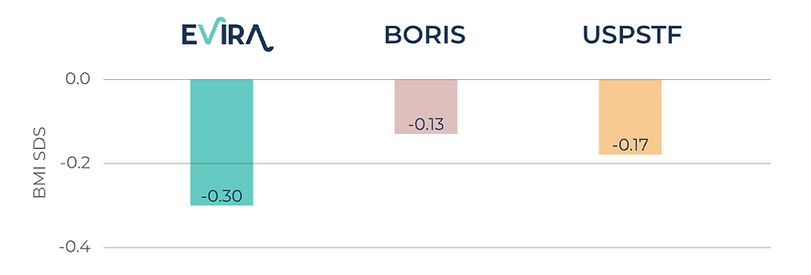
Evira has been evaluated clinically and in research contexts in various forms for several years. Treatment with Evira provides on average twice as good an effect compared to traditional treatment.
1 year
Clear treatment effect
Does the treatment work compared to conventional care?
3 years
Maintained long-term results
Do the results last over time?
Abu Dhabi
Comparable results in a different healthcare and cultural context
Can the model work in another healthcare context?
One-year study in clinical practice
In our one-year study together with prominent researchers from Karolinska Institutet, the first 107 patients at Martina Barnsjukhus Centrum för Vikthälsa used Evira’s platform and treatment method for one year. A matched control group of 321 patients was randomly selected from the national quality register BORIS who received traditional childhood obesity treatment during the same period. The intervention group using Evira had a relative weight loss of 0.30 BMI SDS units, compared to the control group who on average gained 0.15 BMI SDS units.
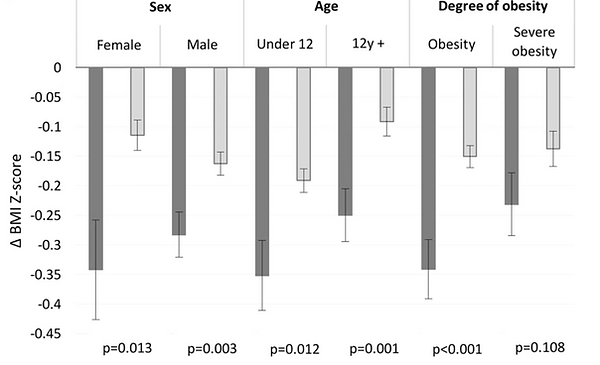
Mean change in BMI SDS for Evira patients (dark grey) and the control group of BORIS patients (light grey) after 1 year of treatment, broken down by gender, age, and degree of obesity in the one-year study.
In addition to seeing twice as good treatment results with Evira compared to traditional treatment, we observed a significant effect on teenagers – a treatment group that has historically been very difficult to reach with traditional treatment.
Long-term effects of digital treatment for obesity: Three-year follow-up
This study from Karolinska Institutet, which is a follow-up to our previous one-year study and is based on the same cohort, shows that the relative weight loss achieved by children and young people with the digital treatment tool Evira after one year of treatment was maintained for up to three years.
Patients treated with the digital tool had more than twice the reduction in BMI SDS (degree of overweight) and a higher proportion reached below the obesity threshold compared to a group receiving conventional standard treatment.
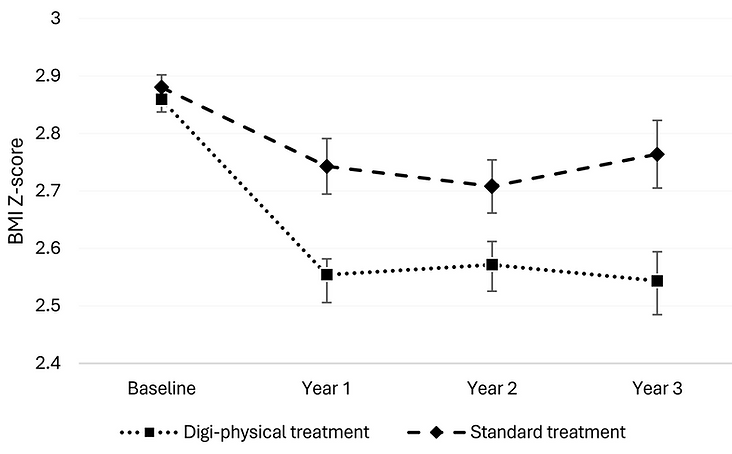
Average change in BMI Z-score for patients in the digi-physical treatment group (dotted line) and standard treatment group (dashed line) over three years, adjusted for sex, age, and degree of obesity at the start of treatment.
The three-year pragmatic clinical study, which followed 428 children and young people aged 4–17 years, compared two groups: one treated with the digital tool Evira (n=107) and a control group receiving conventional standard treatment (n=321).
The prevalence of disordered eating behaviour and eating disorder diagnoses was investigated in the group receiving digital treatment throughout the treatment period and one year after treatment completion. During follow-up, three patients showed signs of disordered eating behaviour, all with pre-existing contact with specialist psychiatric care. No patient received an eating disorder diagnosis during the study.
Key results
- The relative weight loss, which was twice as large at one year compared to the control group, was maintained for up to three years in patients treated with the digital tool.
- Patients treated with the digital tool had a 70% higher chance of achieving remission, i.e. reaching below the obesity threshold, compared to patients receiving standard treatment.
- Adherence to treatment was higher in the group treated with the digital tool, where a significantly lower proportion discontinued treatment compared to patients in standard treatment.
- No patient treated with the digital tool developed an eating disorder diagnosis during treatment or the subsequent year.
International study · 2026
Comparable results in Abu Dhabi and Stockholm
A peer-reviewed study in BMC Pediatrics compared Evira-supported obesity treatment for children in Abu Dhabi with a comparison group from Stockholm. After 26 weeks, the adjusted change in BMI z-score was −0.20 in both groups, meeting the study's predefined non-inferiority criterion.
The study provides early support that the treatment model can also work in a distinctly different healthcare and cultural context.
- Abu Dhabi, United Arab Emirates + Stockholm, Sweden
- 26 weeks
- Peer-reviewed · BMC Pediatrics
Attrition was higher in the Abu Dhabi group than in Stockholm (41.7% compared to 28.0%). The results therefore provide promising evidence for transferability to an additional healthcare context, not proof of general applicability in all healthcare systems.
Read the study →Feasibility study
In Evira’s early stages, the platform was tested in a small feasibility study at three clinics over six months. The study showed good treatment efficacy after six months compared to traditional treatment, and also showed that patients and healthcare professionals were very satisfied with the platform.
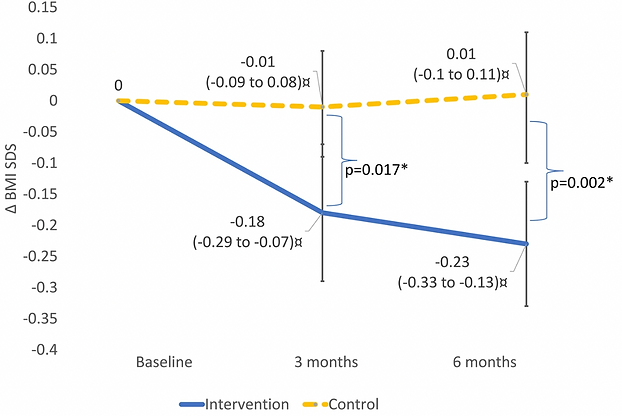
Change in BMI SDS from baseline to follow-up at three and six months for the intervention and control group in the feasibility study.
Almost all in the intervention group using Evira reported that Evira helped them achieve their treatment goals, and that it was easier to get in touch with healthcare professionals at the clinic. Families using Evira were significantly more satisfied with the treatment outcomes compared to the control group.
Doctoral thesis by Linnea Johansson
Linnea Johansson, Ph. D, has in her doctoral thesis researched, among other things, mobile health interventions with Evira as the main focus. She highlights several important lessons learned about how to approach digital treatment and analyses what has and has not worked during Evira's development period. She concludes by stating that digital health interventions together with clinical visits, such as Evira, provide better treatment efficacy than behavioural treatment alone. Linnea also places great emphasis on the importance of the technical maturity of digital systems, and the importance of educating clinic staff on how clinical treatment with the help of digital support systems should be conducted.
Process evaluation of an RCT – how Evira went from prototype to scalable treatment tool
Between 2018–2019, a randomised controlled study was conducted using an early digital prototype tool for the treatment of children with obesity – a first step in the development of what is today Evira. Following the RCT, a process evaluation was carried out to identify challenges and insights related to implementation and use. These learnings have been central to the long-term, user-centred development work that has shaped Evira into the treatment tool it is today. Evira has since been further developed in close collaboration with healthcare professionals and patients to meet needs – both technically and pedagogically. Evira is now more intuitive, technically mature, and offers real-time support as well as structured training for healthcare providers. From an initial prototype, Evira has grown into an evidence-based, scalable tool – developed to work in practice.
Both the RCT and the process evaluation were conducted by researchers at Karolinska Institutet.