
The treatment flow
How Evira works in healthcare
The healthcare provider leads the treatment. Evira maintains close contact between visits. The family is an expert on their own situation and seeks help and support from the healthcare provider to achieve their goal – together with Evira's digital tools and measuring platform.
Treatment step by step
The treatment is the same as the care already provides: combined lifestyle treatment. Evira is the digital support that makes it possible to maintain regular contact between physical visits.
1. Physical visits
The family
Meets their healthcare professional for a physical visit and gets started with the app and scales at home. Together, the initial goals are set.
The healthcare provider
Performs their usual assessment, sets treatment goals, and starts the treatment in Evira.
2. Lifestyle habits step by step
The family
Works with sustainable changes in small, concrete steps that fit into the family's everyday life.
The healthcare provider
Follows the combined lifestyle treatment and adjusts the content according to the family's situation.
3. Evira at home
The family
The child weighs themselves at home on a connected scale. The weight is sent automatically and nothing needs to be reported manually.
The healthcare provider
Sees weight development as a trend over time instead of individual data points during visits.
4. Digital follow-up
The family
Can ask questions in the app and receive feedback without having to wait until the next visit.
The healthcare provider
Provides short, targeted interventions digitally and maintains regular treatment contact throughout the year.
The cycle is repeated between visits. Visits every 3–6 months.
Measurement
One measurement, two completely different views
The child weighs themselves at home and the weight is automatically sent on. The family sees the direction towards the goal. The healthcare provider sees each individual data point.
In the app at home
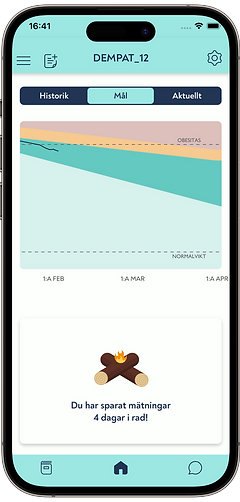
No figures and no weight in kilos. The child sees their development in relation to the goal, and that the measurements have been taken.
In the healthcare provider's view
Each measurement point in BMI SDS throughout the entire treatment period, with individual height estimation and the obesity threshold marked. Measurement points can be managed directly in the diagram.
The reference line in the family's view is the treatment goal set by the healthcare provider. The family works towards a direction, not a value.
Treatment philosophy
The treatment philosophy shapes how the conversation is held
Combined lifestyle treatment works when the family owns the solution and the care provider follows the direction. Evira makes progress visible between visits.
This is how we work
The scale is the answer key
You quickly see whether they are heading in the right direction, and can act early if the curve turns upwards.
The parents carry the responsibility
They need your support and help, and they follow the weight development in everyday life.
Be encouraging
Acknowledge small steps and keep motivation up between visits.
Ask the question back
“What do you think you could do yourselves?” produces solutions the family can actually stick to.
This is what we avoid
Don't tell them how to do it
Ready-made answers take ownership of the change away from the family.
Detailed meal plans
They are rarely followed and make follow-up unclear.
Don't lie to the family
Don't say something is going well when it isn't.
Don't wait until the next visit
Act when the trend turns, not several months later.
The family are experts on their own everyday life. The care provider contributes medical knowledge and direction, and checks progress between visits.
Follow-up
The system highlights. The healthcare provider assesses.
Measurement values are continuously compared against the child's own trend. When development deviates, the patient appears higher up in the healthcare provider's view.
That's where the decision comes in. Evira highlights which patients are worth a closer look.
Prioritisation by treatment, not calendar
Families who need more support can receive it earlier, instead of waiting for their turn in the appointment calendar.
Over time
Contact is adjusted according to progress
Obesity is a long-term condition and treatment does not end on a specific date. The frequency of contact follows development instead of the calendar.
During treatment
The family
Measures regularly, works with one lifestyle area at a time and asks questions in the app.
The healthcare provider
Continuously monitors the trend and provides short, targeted interventions between visits.
When goals are reached
The family
Continues to measure at their own pace and retains access to their support in the app.
The healthcare provider
Monitors the child with regular check-ups in line with the treatment programme's recommendations.
If development reverses
The family
Regains contact without having to lose their referral or wait for the next appointment.
The healthcare provider
Sees that the trend is broken before it is visible at a visit and can resume treatment.
Roles and responsibilities
Evira enables contact. Healthcare providers conduct the treatment.
Nothing in Evira replaces a healthcare contact or a medical assessment. The tool makes the existing contact closer and better substantiated, and responsibility for the care remains with the healthcare provider throughout.
- The healthcare provider sets treatment goals, assesses development, and decides on actions.
- The family works on their lifestyle habits at home and measures in their everyday life.
- Evira maintains regular contact and makes the basis visible to both.